What if we could turn the longevity ecosystem’s insights and experiences into collective wisdom?
The New Longevity BrAIn is turning that vision into reality. It bridges the Global South and North in a trusted, AI-powered space where changemakers learn from each other, uncover what works, and transform insights into meaningful, scalable impact.
What if we could turn the longevity ecosystem’s insights and...
Why New Longevity BrAIn
Because longer lives demand smarter systems, and smarter systems rely on collective wisdom.
Today, knowledge about longevity is scattered across regions, sectors, and silos. Insights from social innovators, researchers, communities, civil society, media, and governments often remain disconnected—especially between the Global South and North. This fragmentation slows progress and limits our ability to learn how different societies are reimagining the future of aging.
Created by Ashoka New Longevity and Apurva.ai, the New Longevity BrAIn is a trusted, AI-powered engine designed to enable changemakers and institutions make faster, more informed decisions rooted in real voices from the ecosystem.
This is not just technology. It is a shared intelligence system, built with and for the longevity ecosystem.
Every piece of content in the New Longevity BrAIn is thoughtfully curated by the Ashoka New Longevity team to reflect the lived experiences of changemakers and the complex realities of aging across diverse contexts. We gather, verify, and organize publicly available knowledge from across sectors—public, private, academic, media, and civil society—transforming scattered insights into actionable, systemic solutions for the longevity ecosystem.
This makes the BrAIn not only a rich source of content, but also a trusted companion for those designing innovative and inclusive responses to the challenges and opportunities of aging.
What the New Longevity BrAIn Can Do
In Brazil, the New Longevity BrAIn played a pivotal role in mapping the country’s social innovation ecosystem for Longevity. By identifying over 400 initiatives ranging from community-based care models to intergenerational employment programs, it transformed fragmented data into structured intelligence.
The BrAIn uncovered patterns that would have otherwise gone unnoticed, revealing how factors like geography, race, and gender shape aging experiences. It also highlighted the core design principles behind successful local innovations. These insights supported the creation of learning clusters, helped changemakers understand their place within a wider system, and guided decision-makers toward high-impact opportunities for investment and collaboration.
In Spain, the BrAIn supported a growing movement to rethink work, care, and purpose in an aging society. It mapped key social entrepreneurs and emerging solutions across regions, helping stakeholders grasp how challenges like depopulation, ageism, and loneliness are linked to broader social and economic shifts.
More than a research tool, the BrAIn established a shared language for longevity innovation—surfacing scalable models, fostering cross-sector collaboration, and offering actionable insights for both regional and national policy. By organizing and amplifying local knowledge, the BrAIn has become a catalyst for systemic change in how societies respond to aging.
One of the key steps to reimagining the way we age is understanding the diversity of aging. Aging is a deeply personal experience, shaped by cultural values, socioeconomic conditions, and lived within territories. The New Longevity BrAIn supports social innovators in finding collaborators and learning from one another across these varied contexts.
By exploring both similarities and contrasts in legal frameworks, infrastructure, and more, the BrAIn helps the longevity ecosystem contextualize needs, see the bigger picture, and reimagine what scalable impact can look like. This collective wisdom strengthens our narratives on aging, making them more robust and compelling, and helps advance the New Longevity paradigm, where everyone can thrive and contribute as they age.
What is Coming Next?
The New Longevity BrAIn has been weaving together knowledge from multi-sector stakeholders around the world. Now, we’re turning our focus to the voices of older people themselves: their stories, their contributions, their legacy. In the coming months, we will launch a listening tool designed to reach into communities, homes, and local networks, meeting older adults where they are and inviting them to speak, to share, and to shape the future of aging.
With this step, the New Longevity BrAIn moves closer to a world where Everyone is a Changemaker — a world where people of all ages contribute to the solutions we urgently need. More than just listening, this tool will support social innovators in understanding their impact and help the broader ecosystem learn directly from lived experience, ensuring our strategies are grounded in the voices that matter most.
Artificial Intelligence sparks mixed feelings—its power depends on how we choose to use it. That’s why I joined Ashoka’s New Longevity BrAIn with enthusiasm.
Having verified, accessible information at my fingertips gives me confidence. It’s my favorite platform!
Ximena Abogabir
Cofounder Travesia100, Chile
I see immense potential in how the New Longevity BrAIn could help us not only manage existing knowledge more efficiently but also unlock new levels of collective understanding. I am excited about the possibility of leveraging such a platform to further our mission.
Providence Jongwedzvuku
Head of Global Brand and Communications, The Friendship Bench Zimbabwe
It’s amazing how this artificial intelligence focuses specifically on information about aging and older adults, making the answers more accurate and useful. Plus, the inclusion of sources enhances its credibility, showing a real commitment to clarity and reliability.
Yélena de Fátima Monteiro Araújo
Justice Prosecutor and Coordinator of the Elderly People’s Program at the Public Prosecutor’s Office of Pernambuco (MPPE), Brazil
Africa is the youngest continent, but in 50 years, today’s youth will be aging. As a Venture Manager, I need foresight, clarity, and long-term vision. The New Longevity BrAIn helps me identify innovators and act now to shape a better aging future for the continent.
Tchanlandjou Kpare
Regional Director, Sahel, Ashoka
Working with the New Longevity Brain transformed how we mapped the ecosystem in Spain. It helped us surface insights, spot patterns, and ask better questions—faster. It’s more than a tool—it’s a co-pilot for deeper, smarter thinking on longevity.
We are building an AI-powered platform rooted in the values of changemaking across the globe. A space where everyone can engage, contribute, learn and thrive.
This User Charter brings together our Terms of Use, Privacy Policy, and Ethical Guidelines. Together, these documents explain how we operate, how we protect your information, and the principles that shape your experience on the platform. They reflect our commitment to transparency, responsible AI, and inclusive engagement. The Charter applies globally and aligns with leading privacy and ethical standards, including the GDPR and LGPD. The New Longevity BrAIn is created by Ashoka New Longevity and Apurva.ai, in collaboration with trusted partners who support a secure, adaptive platform.
We are glad you are here. By using the New Longevity BrAIn, you agree to our shared principles and values.
What Languages Does the New Longevity BrAIn Understand?
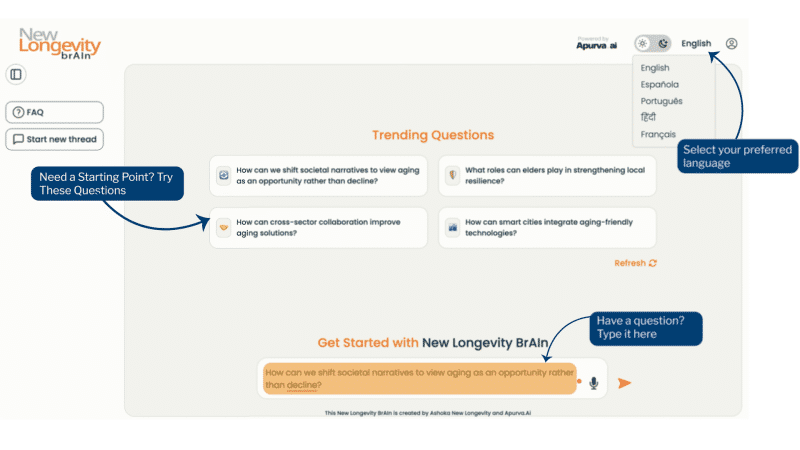
You can ask questions, use suggested prompts, or create your own—in English, Spanish, Portuguese, French and Hindi. We are committed to expanding our language capabilities to include more languages and reach diverse communities around the world.
For now, English is the default language. To switch to Spanish, Portuguese,French or Hindi simply click “English” in the top-right menu and select “Español”, “Português”, Français, or Hindi from the dropdown.
Have a Question? Check Our Frequently Asked Questions
What is the New Longevity BrAIn?
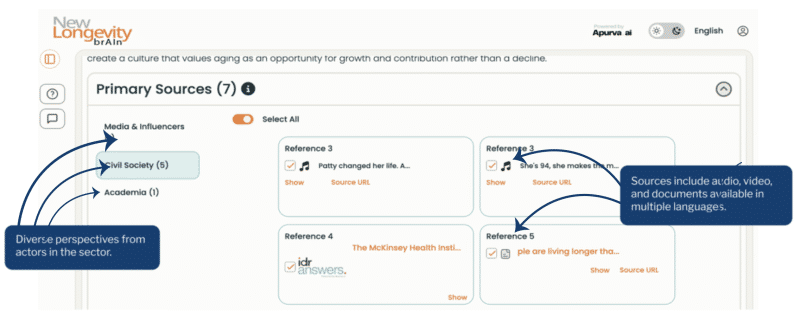
The New Longevity Brain is an AI-powered search and knowledge engine developed by Apurva.ai and Ashoka New Longevity to support changemakers in the field of longevity and aging. It provides access to cross-sector collective intelligence—drawing from social innovators, researchers, communities, government, market, and media actors—and transforms diverse insights into actionable knowledge for individuals and institutions working to address social challenges and drive systemic change.
What makes the New Longevity BrAIn different from other AI platforms?
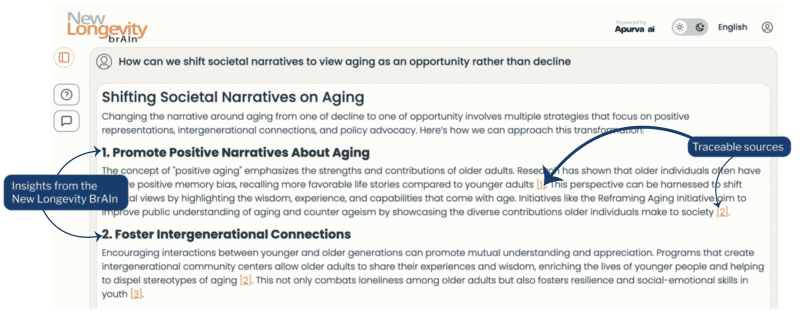
Unlike general-purpose AI platforms, the New Longevity Brain is specifically designed to advance social impact in the field of longevity and aging. It draws from curated expert knowledge, incorporates lived experiences from communities (including older adults), and is governed by a set of ethical guidelines, privacy safeguards, and transparency standards that ensure fairness, relevance, and contextual accuracy.
How does the New Longevity BrAIn work?
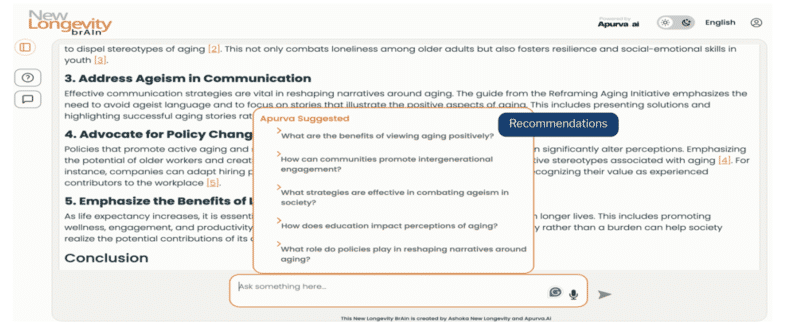
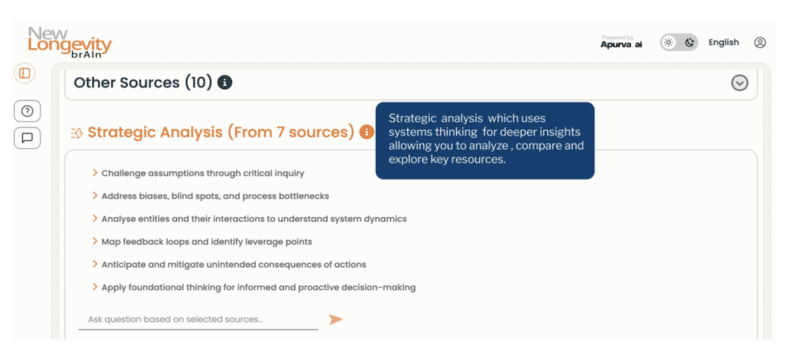
Users submit questions through the platform’s interface (including via WhatsApp or website). The AI engine analyzes these questions using structured and unstructured datasets curated by Ashoka and its partners, then delivers synthesized, actionable insights. It also highlights systemic interdependencies, addresses biases, and anticipates unintended consequences to support changemakers in navigating complex social ecosystems.
What types of questions work best on the New Longevity BrAIn?
The platform excels with questions that are systemic, intersectional, and open-ended. For example:
How can intergenerational learning enhance community health?
What policies are most effective in combating ageism in the workplace?
How does caregiving affect women’s economic participation in Chile?
What are the systemic barriers to older adults accessing digital services?
How does caregiving intersect with gender and economic inequality in the Global South?
Highly specific, statistical, or transactional questions may not yield accurate results unless they are grounded in systemic inquiry.
Are there questions the New Longevity BrAIn doesn’t answer well?
Yes. The New Longevity Brain is not a database or directory but a systemic analysis tool. It may not perform well with highly specific, transactional, or purely statistical questions—such as requests for exact figures, exhaustive lists, or time-bound data—especially when they lack a contextual dimension. For example:
“List all organizations working with older people in São Paulo.”
“What’s the unemployment rate of older adults in 1995?”
Why do I need to log in to use the New Longevity BrAIn?
To ensure a secure, personalized, and responsible experience, the platform requires you to log in through a trusted third-party service (such as Google or LinkedIn). This helps:
Improve your experience through customized responses;
Prevent misuse, spam, or abuse;
Track usage anonymously to improve system functionality;
Promote accountability and safety across the platform.
We do not publish anything on your behalf, and we do not use your data for advertising purposes.
How is my data used?
We collect data such as your queries, preferences, and usage patterns to improve platform functionality. This data:
Is anonymized;
May be used to identify trending questions;
Is stored securely and never sold or used for targeted advertising;
Is processed in accordance with international data protection laws and Ashoka’s Privacy Policy.
You can request deletion, correction, or export of your data at any time by contacting us.
You can also access our Terms of Use and Privacy Policy to check our latest data policies and understand your rights.
How does the New Longevity BrAIn handle AI ethics and biases?
The platform is governed by strict Ethical Guidelines. It is designed to:
Prevent harmful, misleading, or discriminatory outputs;
Promote inclusive, respectful, and socially responsible use;
Encourage users to apply critical thinking and not treat AI responses as final truth;
Invite feedback and corrections to continuously refine the system.
Users who violate the ethical code (e.g., to provoke or spread disinformation) may be suspended or blocked.
What should I keep in mind when using AI-generated insights?
The New Longevity Brain’s outputs are supportive tools, not professional or legal advice. Users are responsible for:
Evaluating outputs critically;
Providing context when sharing insights publicly;
Ensuring ethical, legal, and culturally appropriate application of results;
Not misrepresenting AI outputs as definitive or exclusive.
The New Longevity Brain’s outputs are NOT designed to replace human judgment. While AI-generated insights can enhance understanding and inform action, they are not a substitute for professional expertise, critical thinking, or ethical responsibility. Users must evaluate the outputs carefully and apply their own discernment when making decisions, especially in areas like health, policy, or finance.
Can I use the content generated by the New Longevity BrAIn?
Yes—with conditions. You may use AI-generated insights for personal, academic, or organizational purposes, but:
You must not claim ownership of the underlying AI system or method;
You should attribute outputs properly when sharing;
You may not use outputs to promote harm, discrimination, or misinformation.
Who can use the New Longevity BrAIn?
It is designed for:
Social innovators and changemakers;
Researchers and policymakers;
Funders and philanthropic organizations;
Older adults and community leaders;
Anyone interested in transforming systems related to aging and longevity.
Users must be 18+ or use the platform under parental supervision if younger.
Where is my data stored?
Data will be processed in the United States or other countries that meet data protection standards (e.g., GDPR in Europe or LGPD in Brazil). All transfers follow legal protocols, and user privacy is protected at all times.
What happens in case of a data breach?
In the unlikely event of a data security incident, Ashoka will notify affected individuals and relevant authorities as required by law. All concerns are addressed by our Data Protection Officer (DPO) in accordance with the Privacy Policy. Security protocols, including encryption and verification, are in place to mitigate risks and protect your information.
What happens if these policies change?
You will be informed via email or platform notifications. Continuing to use the platform implies agreement with the updated terms.