
Lifelong contribution changes everything
When we are supported to remain active contributors, through work, caregiving, volunteering, or learning, at every stage of life, we live healthier, longer, and more connected lives. This creates a powerful cycle of contribution, health, connection, and purpose.
For decades, aging has been framed as a period of decline, shaping systems that limit participation later in life. As we live longer, this assumption no longer holds. A new paradigm is emerging, one that recognizes contribution, agency, and purpose across every stage of life.
A framework for system change
To make lifelong contribution possible, change must happen across every dimension of society.
This is the architecture needed to enable participation, contribution, and well-being across longer lives.
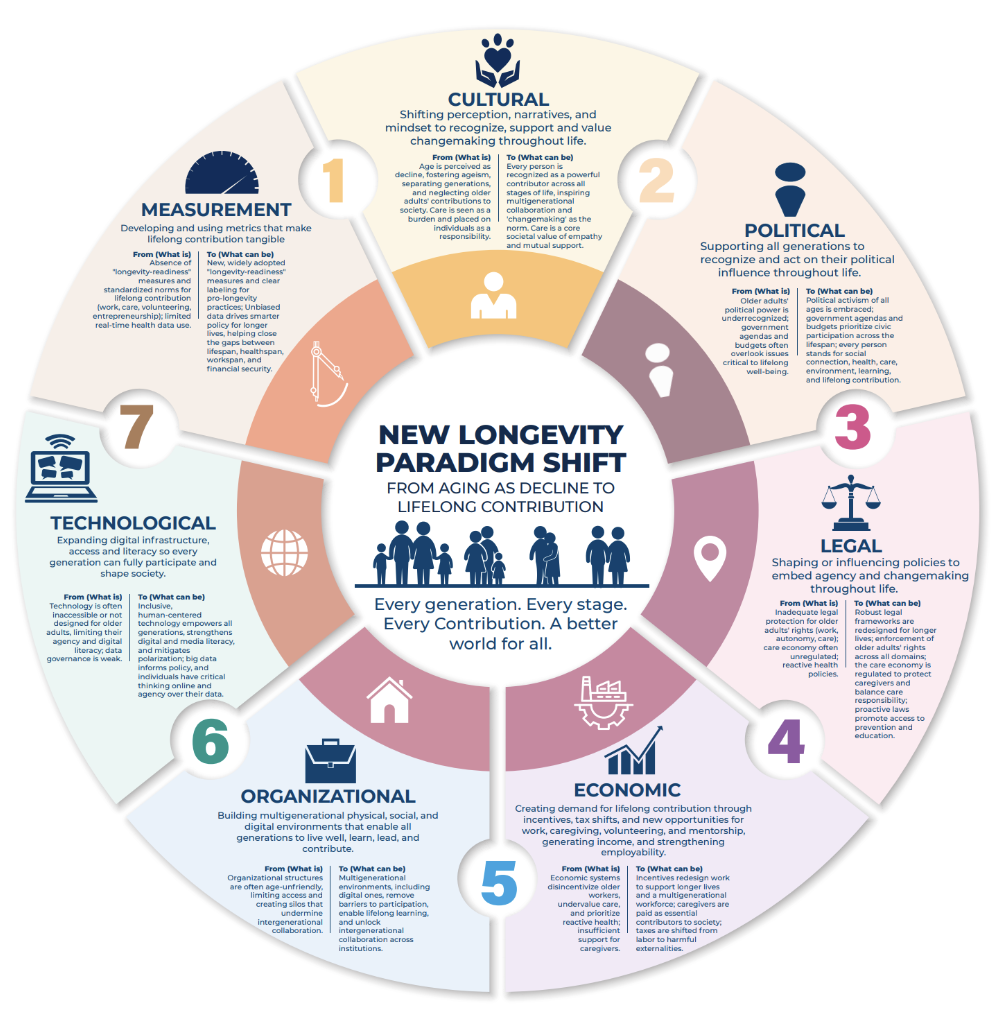
The 7 Dimensions
Longevity Paradigm maps how these transformations unfold and reinforce one another across each of these even dimensions.
What is: Age is perceived as decline, fostering ageism, separating generations, and neglecting older adults' contributions to society. Care is seen as a burden and placed on individuals as a responsibility.
What Can Be: Every person is recognized as a powerful contributor across all stages of life, inspiring multigenerational collaboration and 'changemaking' as the norm. Care is a core societal value of empathy and mutual support.
What is: Older adults' political power is underrecognized; government agendas and budgets often overlook issues critical to lifelong well-being.
What Can Be: Political activism of all ages is embraced; government agendas and budgets prioritize civic participation across the lifespan; every person stands for social connection, health, care, environment, learning, and lifelong contribution.
What is: Inadequate legal protection for older adults' rights (work, autonomy, care); care economy often unregulated; reactive health policies.
What Can Be: Robust legal frameworks are redesigned for longer lives; enforcement of older adults' rights across all domains; the care economy is regulated to protect caregivers and balance care responsibility; proactive laws promote access to prevention and education.
What is: Economic systems disincentivize older workers, undervalue care, and prioritize reactive health; insufficient support for caregivers.
What Can Be: Incentives redesign work to support longer lives and a multigenerational workforce; caregivers are paid as essential contributors to society; taxes are shifted from labor to harmful externalities.
What is: Organizational structures are often age-unfriendly, limiting access and creating silos that undermine intergenerational collaboration.
What Can Be: Multigenerational environments, including digital ones, remove barriers to participation, enable lifelong learning, and unlock intergenerational collaboration across institutions.
What is: Technology is often inaccessible or not designed for older adults, limiting their agency and digital literacy; data governance is weak.
What Can Be: Inclusive, human-centered technology empowers all generations, strengthens digital and media literacy, and mitigates polarization; big data informs policy, and individuals have critical thinking online and agency over their data.
What is: Absence of "longevity-readiness" measures and standardized norms for lifelong contribution (work, care, volunteering, entrepreneurship); limited real-time health data use.
What Can Be: New, widely adopted "longevity-readiness" measures and clear labeling for pro-longevity practices; Unbiased data drives smarter policy for longer lives, helping close the gaps between lifespan, healthspan, workspan, and financial security.